Ever wondered who designs climate-resilient cities, energy-efficient buildings, and greener neighborhoods? Turns out, that’s an actual major.
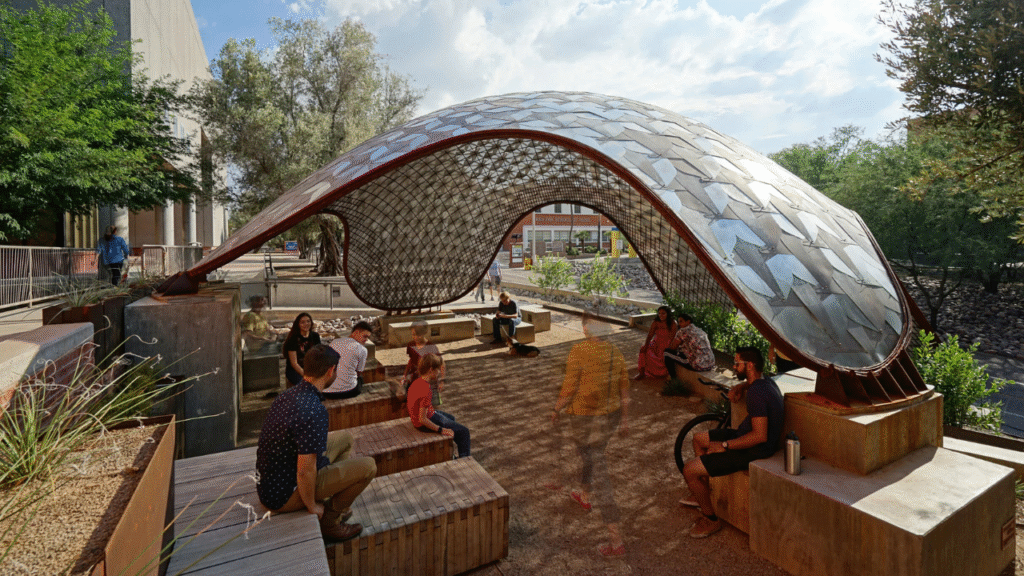
The Sonoran Pentapus outside the University of Arizona’s College of Architecture, Planning and Landscape Architecture, part of a multi-university grid-shell research project. (Photo source: University of Arizona)
At the University of Arizona, students can study the Bachelor of Science in Sustainable Built Environments (SBE) — a degree focused on designing cities and infrastructure that work with the planet instead of against it.
Designing the cities of the future
The Sustainable Built Environments program looks at how the places we build—cities, neighborhoods, buildings, transportation systems—affect the environment.
Instead of approaching sustainability purely from a science or policy angle, the degree focuses on the real-world spaces people live in every day.
The program sits inside the university’s College of Architecture, Planning and Landscape Architecture (CAPLA) and blends sustainability, urban design, and environmental systems. Students explore how urban development impacts energy use, water consumption, and climate resilience.
Courses typically cover topics like sustainable urban planning, climate-responsive architecture, green building design, and infrastructure systems that support more sustainable communities. Students also examine how policy, technology, and design intersect when cities try to become more sustainable.
A desert living laboratory
The location of the University of Arizona makes the degree even more interesting.
The campus sits in Tucson, Arizona, right in the Sonoran Desert. That means students are learning about sustainability in a place that deals with some very real environmental challenges—extreme heat, water scarcity, and rapid urban growth.
Instead of just reading about climate adaptation in textbooks, students often study how cities actually respond to those pressures. Projects can involve desert urban design, climate-responsive buildings, and resource-efficient city planning.
In other words, the city itself becomes part of the classroom.
What it costs to study
For international students, tuition at the University of Arizona is typically around $39,000 to $41,000 per year. Housing and living expenses are estimated at roughly $15,000 to $18,000 annually.
That brings the total estimated cost of attendance to about $55,000 to $60,000 per year, though scholarships and merit awards may be available for qualified international applicants.
Key application dates
International students generally apply for the Fall intake.
The university offers a priority application deadline in November, with a later regular deadline in May. Applying earlier is usually a good idea, especially for international students who will need time to arrange visas, housing, and travel.
Career paths after graduation
Graduates from the Sustainable Built Environments program often go on to careers connected to urban sustainability and environmental planning.
Some work in sustainable development consulting, green building advisory services, urban planning, or climate resilience projects. Others continue their studies in graduate programs such as architecture, urban planning, landscape architecture, or environmental design.
A degree that’s only getting more relevant
Cities are growing fast. By 2050, nearly 70% of the world’s population is expected to live in urban areas. That means the question isn’t just how we protect the environment—it’s how we design the cities people live in without damaging it.