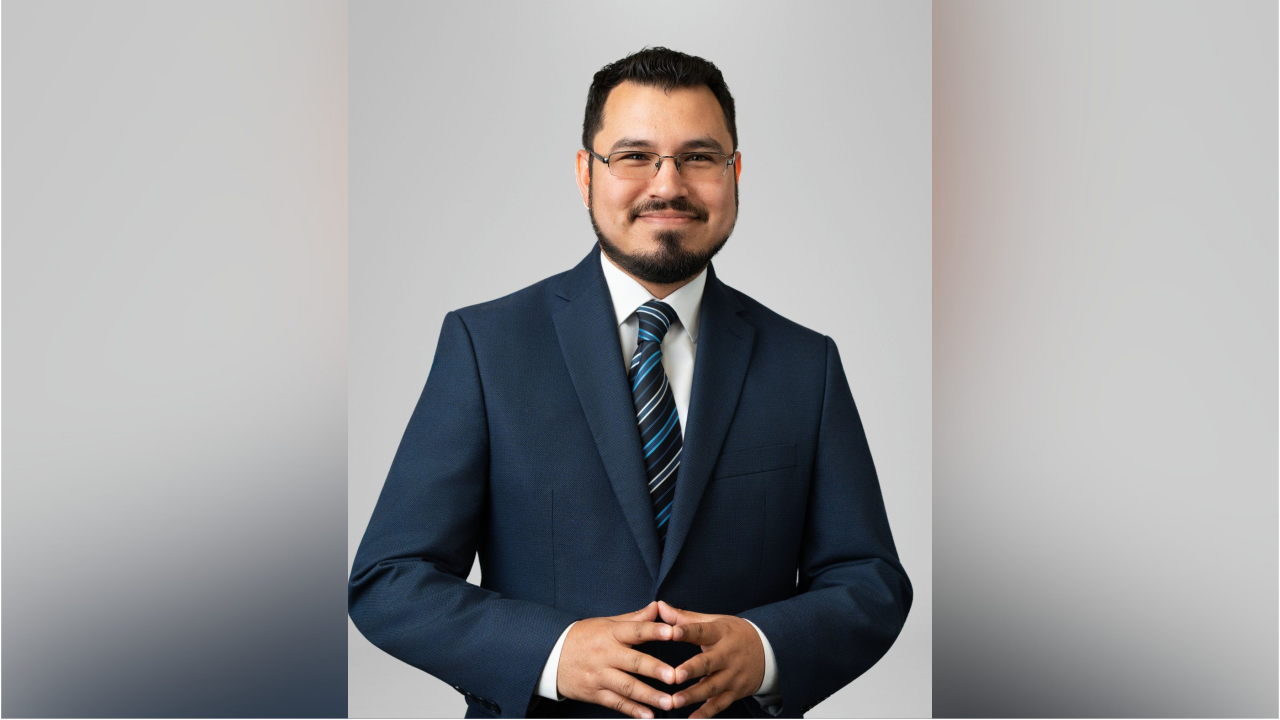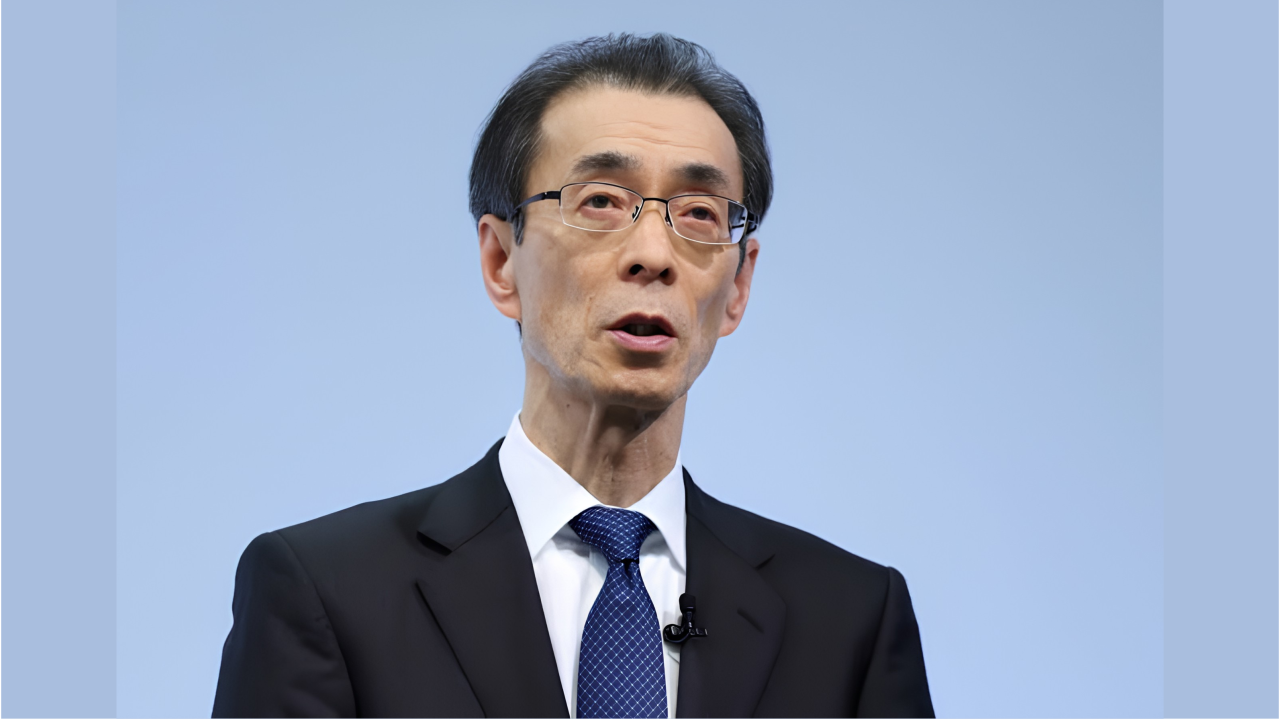

Speaker Thomas Graham Distinguished Fellow, Council on Foreign Relations Presider Irina A. Faskianos Vice President, National Program and Outreach, Council on Foreign Relations Subscribe via iTunesAcademic and Higher Education Webinars and Europe Program Thomas Graham, distinguished fellow at CFR, leads a conversation on constraining Putin’s Russia. FASKIANOS: Welcome to today’s session of the CFR Fall …
Academic Webinar: Constraining Putin’s Russia

Speaker
Distinguished Fellow, Council on Foreign Relations
Presider
Vice President, National Program and Outreach, Council on Foreign Relations
Subscribe via iTunesAcademic and Higher Education Webinars and Europe Program
Thomas Graham, distinguished fellow at CFR, leads a conversation on constraining Putin’s Russia.
FASKIANOS: Welcome to today’s session of the CFR Fall 2021 Academic Webinar Series. I’m Irina Faskianos, vice president of the National Program and Outreach here at CFR. Today’s meeting is on the record, and the video and transcript will be available on our website CFR.org/academic if you would like to share it with your colleagues or classmates. As always, CFR takes no institutional positions on matters of policy.
We are delighted to have Thomas Graham with us to talk about Putin’s Russia. Mr. Graham is a distinguished fellow at the Council on Foreign Relations and a senior advisor at Kissinger Associates, where he focuses on Russian and Eurasian affairs. He is cofounder of the Russian, East European, and Eurasian studies program at Yale University, and is also a research fellow at the MacMillan Center at Yale. He previously served as special assistant to President George W. Bush and senior director for Russia on the National Security Council staff from 2004 to 2007, and director for Russian affairs from 2002 to 2004. His résumé is very distinguished. I will just also say that he is a U.S. diplomat who served two tours of duty in Moscow, where he worked on political affairs.
So, Mr. Graham, thanks very much for being with us today. I thought you could get us started by talking about the primary interests at stake in U.S.-Russia relations.
GRAHAM: Great. Thank you very much, Irina, for that introduction, and it’s a real pleasure to be with all of you here today. I want to start with three broad points that will frame the rest of our discussion.
The first is that the problem that the United States faces is not simply with Putin; it is with Russia more generally speaking. The last seven years of very difficult, challenging adversarial relationship is really not an aberration in the history of the relationship between our two countries. In fact, from the moment the United States emerged as a major power on the global stage at the very end of the nineteenth century, we have had a rivalry with Russia. And the issues that divide us today are the ones that divided us 125, 150 years ago: We have opposing worldviews. We have different geopolitical interests. And clearly, we have different systems of values that inform our domestic political systems. This rivalry has intensified, ebbed and flowed during the twentieth century. But the effort we made at partnership after the breakup of the Soviet Union up until 2014, marked by the eruption of the crisis in Ukraine, is really the aberration in the history of relations between our two countries and one that was founded very much on the fact that Russia endured a period of strategic weakness. So the issue we have to deal with Russia and how we’re going to deal with Russia well into the future, even after Putin departs—which he will, obviously, at some point, if only for biological reasons.
The second point that I would make is that Russia is not going to go away. We hear a lot in the public debate in the United States about Russian decline, about the population/demographic problems it has, about its stagnating economy, and so forth. None of this is necessarily untrue, but I think it tends to exaggerate the problems that Russia faces. It ignores the problems that all other major countries face—including China, the United States, and many major European countries—but it also overlooks the very great strengths that Russia has had for decades that are going to make it a player and an important player on the global stage, nuclear weapons to begin with. We should never forget that Russia remains the only country that can destroy the United States as a functioning society in thirty minutes. Russia has the largest natural endowment of any country in the world, a country that can pretend to self-sufficiency and, in fact, is better placed than most other countries to deal with a breakdown in globalization in the decades to come if that, indeed, happens. It has a veto on the U.N. Security Council, which makes it an important player on issues of importance to the United States, and it has a talented population that has fostered a scientific community that, for example, is capable of taking advances in technology and developing the military applications from them. Just look at the strength that Russia exhibits in cyberspace, for example—again, a major challenge for the United States. So Russia is going to continue to be a challenge.
One other thing that I should have mentioned here is that the Russian state throughout history and Putin’s Russia today has demonstrated a keen ability to mobilize the resources of their own society for state purposes. So even if in relative terms they may be weaker and weakening vis-à-vis China and the United States, in some ways that political will, that ability to mobilize, allows Russia to play a much larger role than mere indicators of its economic size and population size would suggest.
Now, Russia clashes with the United States across a whole range of issues, and as I said that is going to continue for some time. And this brings me to my third point: How we should think about American foreign policy, what our guidelines should be in dealing with Russia. And here there are three, I think, key elements to this.
First, the United States needs to preserve strategic stability. We need to have that nuclear balance between us (sic) and the United States. This is an existential question. And as I already mentioned, Russia does have a tremendous nuclear capability.
Second, the United States should seek to manage its competition with Russia responsibly. We want to avoid or reduce the risk of a direct military conflict that could escalate to the nuclear level. This is—also, I think, recognizes that the United States is not going to be able to compel Russia to capitulate on issues that are of interest to us, nor are we going to be able to radically change the way they think about their own national interests. So it’s a competitive relationship and we need to manage that responsibly.
And finally, given the complex world that we live in today—the very real transnational challenges we face: climate change, pandemic diseases, proliferation of weapons of mass destruction—the United States should seek, to the extent possible, ways to cooperate with Russia in dealing with these issues. We should recognize that Russia is not necessarily the only player nor necessarily the most important player in dealing with these challenges, but it does have a role to play along with other major powers in handling these transnational issues.
So those, I think, are three sort of broad points that help set the stage for our discussion.
Now let me turn sort of very briefly to the questions about U.S. policy. How do we deal with this Russia? What are sort of—the way we should think about American foreign policy? And here the point I would make is that we should think of the policy in terms of what I would call the three Ds: defense, deterrence, and dialogue.
Now, defense and deterrence in many ways go together. If you have a very good defense, if you demonstrate an ability and willingness to defend your interests effectively and deliberately, then you tend to deter another power. They have less reason to want to attack you. But if deterrence fails, you very much need to be able to defend yourself—to disrupt Russian operations in cyberspace, for example, or disrupt military operations by the Russians that you find problematic in some way. So defense and deterrence go together, and we need to think about that.
Now, you build these elements on a number of other things that we’re all familiar with.
A strong military—strong, capable military—is, obviously, an element of both defense and deterrence, and something that we have managed quite well in the past and I imagine will manage quite well going into the future.
Cyber defenses are also an important element of constraining Russia on the global stage. Now, here the United States really has much room for improvement. We built our internet, our cyberspace largely for the accessibility, the ability to pass information from one entity to another, and we spent much less attention to the security of that system. As cyberspace has become more important to our socioeconomic and political lives, we really need to devote much more attention to cybersecurity, hardening our commuter—computer networks, for example, making sure we have strong passwords and so forth, something that I think we now recognize but we need to put a much greater effort into doing that.
Third area of defense and deterrence is strong alliances. When we’re thinking about Russia, this is clearly the transatlantic community, NATO, our relations with our other European partners. And here, we need to develop the types of military/defense cooperation that we need to demonstrate quite clearly that the United States, along with the rest of the NATO allies, is ready and prepared to meet its Article 5 guarantees to collective security should the Russians do something that is untoward in our neighborhood.
And then, finally, and I think of increasing importance, is the question of national unity. National unity, national resilience, has really become a key element in defense and deterrence at this point. We need to demonstrate to the Russians that we have sufficient national unity to clearly identify what our interests are and pursue them on the international stage.
One of Putin’s close colleagues several years ago said that what Putin is doing is messing with the Americans’ minds, and certainly we’ve seen that over the past several years. Putin hasn’t sowed the discord in the United States, but he certainly has tried to exploit it for Russian purposes. And this is something that he’s going to concentrate on in the future, in part because he recognizes the dangers of military confrontation with the United States. So great-power competition, from the Kremlin’s standpoint, is going to move very, very quickly from the kinetic realm to the cyber realm, and we need to be able to deal with that. So building national unity at home, overcoming our polarization, is really perhaps one of the key steps in constraining Russia on the global stage.
And then, finally, some very brief words about dialogue. We tend to downplay this in our national discussion. Many believe that diplomatic relations are—should not be branded as a reward for bad behavior. But I think if you look at this objectively, you’ll see that diplomatic relations are very important as a way of defending and advancing our national concerns. It’s a way that we can convey clearly to the Russians what our expectations are, what our goals are, what our redlines are, and the responses that we’re capable of taking if Russia crosses them. At the same time, we can learn from the Russians what their goals are, what their motivations are, what their redlines are, and we can factor that into our own policy. This is a major element of managing the competition between our two countries responsibly.
You’ll see that we have begun to engage in negotiations and diplomacy with the Russians much more under President Biden than we did under President Trump. We’ve already launched strategic stability talks with the aim of coming up with a new concept of strategic stability that’s adequate to the strategic environment of the present day and the near future. We’ve engaged in cybersecurity talks, which my understanding is have, in fact, had some success over the past several weeks.
Where we, I think, have lagged is in the discussion of regional issues—Europe, Ukraine, the Middle East, for example. These are areas where there is still potential for conflict, and the United States and Russia ought to be sitting down and talking about these issues on a regular basis.
So three Ds—defense, deterrence, and diplomacy or dialogue—are the ways that we should be thinking about our relationship with Russia. And obviously, we’ll need to adjust each of these three elements to the specific issue at hand, whether it be in Europe, whether it be in the nuclear realm, cyberspace, and so forth.
Now, with that as a way—by way of introduction, I am very pleased to entertain your questions.
FASKIANOS: Tom, thanks very much for that terrific overview and analysis.
We’re going to go to all of you now for your questions. You can either raise your hand by clicking on the icon, and I will call on you, and you can tell us what institution you are with; or you can type your question in the Q&A box, although if you want to ask it you can raise your hand. We encourage that. And if you’re typing your question, please let us know what college or university you’re with.
So I’m going to take the first raised-hand question from Babak Salimitari. And unmute yourself.
Q: Can you guys hear me?
GRAHAM: Yes.
FASKIANOS: Yes.
Q: Hello. I’m a third-year UCI student, economics.
I have a question. I’m going to sound a bit like Sean Hannity here, so please forgive me, but I have a question about that Nord Stream 2 pipeline that you constantly hear on the news, and it just doesn’t make that much sense for me of why this pipeline was allowed to be completed into the heart of Europe considering Russia’s strength with natural gases and the leverage that they have over Europe with that pipeline. Why was that allowed to be completed?
GRAHAM: Well, I think from the standpoint of the Biden administration this was a matter of what we call alliance management. Germany is clearly a key ally for the United States in Europe, and the Germans were very committed to the completion of that pipeline, starting with Chancellor Angela Merkel down through I think both the leading political parties and the German business community. So I think they made the decision for that.
But let me step back because I’d like to challenge a lot of the assumptions about the Nord Stream 2 project here in the United States, which I think misconceive it, misframe the question, and tend to exaggerate the dangers that is poses.
The first point that I would make is that Europe now and in the future will have and need Russian gas. It’s taken a substantial amount in the past—in the past decades, and even as it moves forward towards a green revolution it will continue to take considerable amounts of Russian gas. It can’t do without that gas. So the Nord Stream 2 pipeline, contrary to what you hear in the United States or at the U.S. Congress, I don’t think poses an additional threat to Europe’s energy security, no larger than the threat that was posed before that pipeline was completed.
The Europeans, I think are aware of the problems that that poses, and they’ve taken steps over the past several years to integrate the gas—the gas distribution network in Europe, to build facilities to import liquified natural gas, all as a way of eroding the leverage that Gazprom might have had over energy markets in Europe. And that has been quite successful over the past—over the past several years.
Now, I think, you know, the other issue that comes up in the discussion in the United States is Ukraine, because Nord Stream 2 clearly provides Russia with a way to import the gas into Europe and bypass Ukraine at the—at the same time. And Ukraine is going to suffer a significant loss in budgetary revenue because of the decline in transit fees that it gets from the transportation of Russian gas across its territory. You know, that is a problem, but there are ways of dealing with that: by helping Ukraine fill the budgetary gap, by helping Ukraine transition away from a reliance on gas to other forms of energy, of helping Ukraine develop the green-energy resources that will make it a much more important partner in the European energy equation than it is now. And then finally, you know, it strikes me as somewhat wrongheaded for Ukraine to put itself in a position where it is reliant on a country that is clearly a belligerent for a significant part of its federal revenue. So we need to think hard with the Ukrainians about how they deal with this issue, how they wean themselves off Russian transit fees, and then I think we have a situation where we can help Ukraine, we can manage the energy-security situation in Europe, we can reduce any leverage that Russia might have, and that Nord Stream 2 really doesn’t pose a significant risk to the United States or our European allies over the long run.
FASKIANOS: Thank you.
We’re going to take the next question from the written queue from Kenneth Mayers, who’s at St Francis—sorry, that just popped away; oh, sorry—St. Francis College. Thinking beyond this triangular framework, what pathways and possibilities can be envisioned for a more positive dimension of working together in mutually, even globally, beneficial ways?
GRAHAM: What triangular relationship are we talking about?
FASKIANOS: His—thinking beyond this triangular framework and—
GRAHAM: Oh, OK. So I think it’s defense, deterrence, and diplomacy is the—
FASKIANOS: Correct.
GRAHAM: OK. Can you repeat the final part of the question, then?
FASKIANOS: What pathways and possibilities can be envisioned for a more positive dimension of working together in mutually beneficial ways?
GRAHAM: Well, there are a number of areas in which we can work together beneficially. If you think about proliferation of weapons of mass destruction, for example, the United States and Russia over the past two decades have played a major role in both securing weapons that were located in Russia, but also in securing highly-enriched uranium that was in Soviet-designed reactors throughout the former Soviet space. We have taken a lead together in setting down rules and procedures that reduce the risk of nuclear material—fissile material getting into the hands of terrorist organizations. And we have played a role together in trying to constrain the Iranian nuclear program. Russia played an instrumental role in the conclusion of the Joint Comprehensive Plan of Action that we signed in 2015 that the Trump administration walked away with, but they will continue to play a role in constraining Iranians’ nuclear ambitions going forward. And we’ve also worked in a cooperative fashion in dealing with the North Korean nuclear program. So there are areas in nonproliferation where the two countries can work together.
On climate change, I mean, I think the big challenge for the United States is actually persuading Russia that climate change is a significant threat to their own security. They’re slowly beginning to change that view, but as they come around to recognizing that they have to deal with climate change there are a number of areas where the two countries can cooperate.
One of the things that climate is doing is melting the permafrost. That is destabilizing the foundation of much of Russia’s energy infrastructure in areas where gas and oil are extracted for export abroad. The United States has dome technologies that the Russians might find of interest in stabilizing that infrastructure.
They suffer from problems of Siberian fires—peat-bog fires, forest fires—an area that, obviously, is of concern to the United States as well. And there may be room for cooperation there, two.
And then, finally, you know, the United States and Russia have two of the leading scientific communities in the entire world. We ought to be working together on ways that we can help mitigate the consequences of climate change going forward.
So I see an array of areas where the two countries could cooperate, but that will depend on good diplomacy in Washington and a receptivity on the part of the Russians which we haven’t seen quite yet.
FASKIANOS: Thank you.
Let’s go next to Jeffrey Ko. You can unmute yourself. Thank you.
Q: Hi. So I’m Jeffrey Ko. I’m an international relations master’s student at Carnegie Mellon.
And my question has to deal with these private military forces, and especially the Wagner Group. And so I would like to know, you know, how does this play into our security strategy regarding Russia in countries that have seen proxy warfare? And how does this—how difficult will it be to engage with Russia either diplomatically or militarily on the use of these gray-zone tactics, and specifically utilizing the Wagner Group as an informal branch of Russia’s military?
GRAHAM: Well, look, I mean, I do think that we need, one, to sit down and have a discussion with Russia about the use of these private military forces, particularly the Wagner firm, which has played a significant role in a number of conflicts across the globe in the Middle East, Africa, and in Latin America. But we also ought to help the countries that are of interest to us deal with the problems that the Wagner Group causes.
You know, the United States had to deal with the Wagner Group in Syria during the Syrian civil war. You know, despite the fact that we had a deconfliction exercise with the Russians at that point, tried to prevent military conflicts between our two militaries operating in close proximity, when the Wagner forces violated those strictures and actually began to attack a U.S. facility, we had no hesitation about using the force that we had to basically obliterate that enemy. And the Wagner Group suffered casualties numbering in the hundreds, one to two hundred. I think the Russians got the message about that, that you don’t—you don’t mess with the United States military, certainly not while using a private military company like Wagner.
You know, in places like Libya, where Wagner is quite active, I think the United States needs a major diplomatic effort to try to defuse the Libyan crisis. And part of the solution to that would be negotiating an agreement that calls for the withdrawal of all foreign military forces and certainly private military groups from Libyan territory, and lean on the Russians to carry that through.
In any event, you know, this is not going to be an easy issue to resolve. I think we deal with this by—country by country, and we focus our attention on those countries where our national interests are greatest.
FASKIANOS: Thank you.
I’m going to take the next question from Jill Dougherty, who’s at Georgetown University. The Putin administration appears to be hardening its control of Russia’s society with the purpose of keeping Putin in power at least until 2036. Most recent example is the Duma elections that just took place. Will this crackdown domestically affect or damage U.S.-Russia relations?
GRAHAM: Thank you, Jill. Always a good question and always a difficult question to answer.
You know, I think the issue here is the extent to which the Biden administration wants to make the domestic political situation in Russia a key item on its agenda with Russia over the next—over the next few years. You know, my impression from the conversations I’ve had with people in the administration—in and around the administration is that President Biden is not going to focus on this. You know, his focus really is going to be China, and what he wants to do is maintain something of a status quo in the relationship with Russia. You will notice that the second round of sanctions that the United States levied with regard to the poisoning of Alexei Navalny, something that was mandated by U.S. law, were actually quite mild—much less extreme, much less punitive than the legislation allowed—I think a signal that the Biden administration was not going to let domestic political issues in Russia overwhelm the agenda that the United States has, which is going to be focused on strategic stability, cyber issues, and so forth.
So my immediate reaction is that the Duma election is really not going to have a dramatic impact on the state of the relationship between our two countries. We accept the fact that Russia is an authoritarian system. It is becoming more authoritarian. We will continue to try to find ways to support those elements of civil society we can, but always being careful not to do it in ways that causes the Russian government to crack down even harder on those individuals. This is a very sort of difficult needle to thread for the United States, but I think that’s the way we’ll go and you won’t see this as a major impediment to the improvement of relations—which, as we all know, are at a very low level at this point in any event.
FASKIANOS: Great. Thank you.
Let’s go next to Sujay Utkarsh.
Q: Hi, yeah. Can you hear me?
GRAHAM: Yes.
FASKIANOS: Yes.
Q: Awesome.
So, regarding the issue about cyber warfare, I was wondering if you can go into more detail about what advantages the Russians have in cyberspace and what the United States can do to compete with those advantages.
GRAHAM: A good question and a difficult question for people outside the government to answer, since we’re not privy to all the information about Russian cyber capabilities nor are we privy to the information about American cyber capabilities. Both countries cloak those programs in a great deal of secrecy.
You know, it seemed to me that one of the advantages that perhaps Russia has is that it’s a much more closed society than the United States. Now, I’m thinking simply in terms of the way societies can be disrupted through cyberspace. We’re a much more open society. It’s easier to access our internet. We are—just as I mentioned before, we are a polarized society right now. That allows Russia many avenues into our domestic political system in order to exacerbate the tensions between various elements in our society. The United States can’t reply in the same way in dealing with Russia.
You know, second, Russia, in building its own internet, its own cyberspace, has paid much more attention to security than the United States has. So, you know, I would presume that its computer systems are somewhat harder to penetrate than American systems are at this point, although another factor to take into account here is that much of the initial effort in building up cyberspace—the Web, the computer networks—in Russia was built with American technology. You know, the Googles, the Intels, and others played an instrumental role in providing those types of—that type of equipment to the Russians. So I wouldn’t exaggerate how much stronger they are there.
And then, finally, I think what is probably one of the strengths, if you want to call it that, is that Russia is probably a little more risk-prone in using its cyber tools than the United States is at this point, in part because we think as a society we’re more vulnerable. And that does give Russia a slight advantage.
That said, this shouldn’t be a problem that’s beyond the capability of the United States to manage if we put our minds to it. We have done a lot more over the past several years. We are getting better at this. And I think we’ll continue to improve in time and with the appropriate programs, the appropriate education of American society.
FASKIANOS: Thank you.
The next question is a written one from Kim-Leigh Tursi, a third-year undergraduate at Temple University. Where do you see Russia in relation to the rise of China, and how does that affect how the U.S. might approach foreign policy toward Russia?
GRAHAM: Well, you know, that’s an important question, obviously one that a lot of people have focused on recently. You know, Russia and China have developed a very close working strategic relationship over the—over the past several years, but I think we should note that the Russian effort to rebuild its relations with China go back to the late Soviet period to overcome the disadvantages that then the Soviet Union felt they had because of the poor relationship with China and the ability of the United States to exploit that relationship to Moscow’s detriment. So relations have been improving for the past twenty-five, thirty years; obviously, a dramatic acceleration in that improvement after 2014 and the breakdown in relations between Russia and the West.
Now, there are a number of reasons for this alignment at this point.
One, the two countries do share at a very general level a basic view of for—a basic dislike of what they see as American ambitions to dominate the global—the global security and economic environment. They don’t like what they consider to be American hegemonic goals.
Second, the economies seem to be complementary at this point. Russia does have a wealth of natural resources that the Chinese need to fuel their robust economic growth. You have similar domestic political systems.
And all of this, I think, is reinforced by what appears to be a very good personal relationship between President Putin and President Xi Jinping. These two leaders have met dozens of times over the past five to seven years and have maintained, I think, very robust contact even during the—during the pandemic.
So there are very good strategic reasons why these two countries enjoy good relations. They are going to step those up in the near term. The Russians are continuing to provide the Chinese with significant sophisticated military equipment. They’ve also undertaken to help the Chinese build an early warning system for ballistic missiles, and when that’s completed it will make China only the third country in the world to have such a system along with Russia and the United States.
Now, I would argue that this strategic alignment does pose something of a challenge to the United States. If you look at American foreign policy or American foreign policy tradition, one of the principles that has guided the United States since the end of the nineteenth century, certainly throughout the twentieth century, was that we needed to prevent the—any hostile country or coalition of hostile countries from dominating areas of great strategic importance, principally Europe, East Asia, and more recently the Middle East. A Russian-Chinese strategic alignment certainly increases the chances of China dominating East Asia. Depending on how close that relationship grows, it also could have significant impact on Europe and the way Europe relates to this Russian-Chinese bloc, and therefore to the United States as a whole.
So we should have an interest in trying to sort of attenuate the relationship between the two countries. At a minimum, we shouldn’t be pursuing a set of policies that would push Russia closer to China. Second, I think we ought to try to normalize our diplomatic relationship with the Russians. Not that we’re necessarily going to agree on a—on a range of issues at this point, but we need to give the Russians a sense that they have other strategic options than China going forward—something that would, I think, enhance their bargaining position with the Chinese going forward and would complicate China’s own strategic calculus, which would be to our advantage. I think we also should play on Russia’s concerns about strategic autonomy, this idea that Russia needs to be an independent great power on the global stage, that it doesn’t want to be the junior partner or overly dependent on any one country as a way, again, of attenuating the tie with China.
The one thing that I don’t think we can do is drive a wedge between those two countries, in part because of the strategic reasons that I’ve mentioned already that bring these two countries together. And any very crude, I think, effort to do that will actually be counterproductive. Both Beijing and Moscow will see through that, quite clearly, and that will only lead to a closing of the ranks between those two countries, which as I said is a strategic challenge for the United States going forward.
FASKIANOS: Thank you.
I’m going to take the next question from Holli Semetko, who’s at Emory University. Polarization is something we must overcome, as you said, but those of us working on social media have some evidence to suggest that social media has fostered political polarization in the U.S. Yuri Milner, a Russian Israeli entrepreneur, invested in an early round of Facebook funding with help from VTB, a Russian state-controlled bank, as well as his investment in Jared Kushner’s real estate firm. What is the level of FDI from Russia in the U.S. and do you see it as a threat to national security?
GRAHAM: Well, look, I mean, the actual level of Russian FDI in the United States is quite small. You know, you have some few, I think, good examples of it—the one that you’ve mentioned with Yuri Milner, for example. There was some investment in a steel factory some years ago. But by and large, there hasn’t been a significant amount of Russian foreign direct investment in the United States. I think our growing concerns about Russia have made us even more leery of allowing Russian investment, particularly in sectors that we consider critical to American national security. So I’m not deeply concerned about that going forward.
I think we probably face a much greater challenge from the Chinese in that regard. Of course, you’ve seen efforts by the United States to deal more harshly or look more closely at Chinese investment in the United States over the past several years.
Let me just make one sort of final point on social media since it’s come up. You know, Russia is a problem. We need to pay attention to Russia in that space. But again, I don’t think that we should exaggerate Russia’s influence, nor should we focus simply on Russia as the problem in this area. There is a major problem with disinformation in social media in the United States, much of that propagated by sources within the United States, but there are a host of other countries that also will try to affect U.S. public opinion through their intrusions into American social media.
You know, given our concerns about First Amendment rights, freedom of speech and so forth, you know, I think we have problems in sort of really clamping down on this. But what we need to do, certainly, is better educate the American public about how to deal with the information that crosses their electronic devices day in and day out. Americans need to be aware of how they can be manipulated, and they need to understand and know where they can go to find reliable information. Again, given the political polarization in our country today, this is a very real challenge and difficult one. But I think if we think long term about this problem, the key really is educating the American public. An educated American public is going to be the best defense against foreign countries, other hostile forces trying to use social media to undermine our national unity and exacerbate the politics of our country.
FASKIANOS: Thank you.
I’m going to take the next question from Eoin Wilson-Manion, who’s raised his hand.
Q: Hello. Can you hear me now?
GRAHAM: Yes.
FASKIANOS: Yes.
Q: Awesome. Well, thank you.
I just wanted to ask if you could touch a little bit more on Russia’s presence in Syria and what that means for U.S. interests in Syria and I guess the larger Middle East.
I’m Eoin from Carnegie Mellon University. Thanks very much.
GRAHAM: Well, you know, the Russians entered Syria in 2015 militarily largely to save Assad from what they thought was imminent overthrow by what they considered a radical Islamic force, a group of terrorists that they thought would challenge Russian interests not only in Syria but would fuel extremist forces inside Russia itself, particularly in the North Caucasus but farther afield than that—even into Moscow, into areas that were Muslim-dominated inside Russia itself. So they had very good national security reasons for going in.
Those ran—I mean, the Russian presence in Syria clearly has run counter to what the United States was trying to do at that point since we clearly aligned against Assad in favor of what we considered moderate reformist forces that were seeking a more sort of democratic future for Syria as part of this broader Arab Spring at that time. So there was a clear conflict at that point.
You know, subsequently and in parallel with its continued presence in Syria, the Russians have extended their diplomatic—their diplomatic effort to other countries in the region. Russia enjoys a fairly robust diplomatic relationship with Israel, for example, that has been grounded in counterterrorism cooperation, for example. They have a sort of strange relationship, largely positive, with Turkey that they have pursued over the past several years. We know of the ties that they’ve had in Tehran, in Iran for some time. They have reached out to the Saudis and the Saudis have bought some military equipment from them. We see them in Egypt and Libya, for example. So they’re a growing presence, a growing diplomatic presence in the Middle East, and this does pose some problems for the United States.
From the middle of the 1970s onward, one of the basic thrusts of American foreign policy was to limit the role the Russians played in the Middle East. We sidelined them in the negotiations between the Arabs and the Israelis in the 1970s and in the 1980s. We limited their diplomatic contacts to countries that we considered critical partners and allies in that part of the world. Now I think the geopolitical situation has changed. Our own interest in the Middle East has diminished over time, in part because of the fracking revolution here in the United States. Gas and oil, we’ve got close to being independent in that area. We’re not as dependent on the Middle East as we once were for energy sources. And also, as, you know, the Biden administration has been clear, we do want to pivot away from the Middle East and Europe to focus more of our energies on what we see as the rising and continuing strategic challenge posed by China.
So I think that means that going forward the United States is going to have to deal with Russia in a different fashion in the Middle East than in the past. We’re going to have to recognize them as a continuing presence. We’re not going to be able to push them out, in part because we’re not prepared to devote the resources to it. We have countries that are still important to us—Saudi Arabia, Israel for example—that do want a Russian presence in the Middle East. And so what we ought to do, it seems to me, is to begin that discussion about how we’re going to manage the rivalry in the Middle East.
Now, it’s not all simply competition. There are areas for cooperation.
We can cooperate in dealing with Iran, for example, the Iran nuclear dossier, as we have had in the past. Neither country has an interest in Iran developing nuclear weapons.
Second, I think the two countries also would like to see a Middle East that’s not dominated by a single regional power. So despite the fact that the Russians have worked together quite closely with the Iranians in Syria, they don’t share Iranian ambitions elsewhere in the Middle East. And if you look at the diplomatic ties that the Russians have nurtured over the past with Turkey, with Israel, Saudi Arabia for example, none of these are friends of Iran, to put it mildly.
So we can talk, I think, to the Russians of how our—you know, we can conduct ourselves so as to foster the development of a regional equilibrium in the Middle East that tends to stabilize that region, makes it less of a threat to either country, less of a threat to America’s European allies, and use this as a basis for, again, sort of not escalating the tension in the region but moderating it in some ways that works to the long-term advantage of the United States.
FASKIANOS: Next question from Michael Strmiska, who’s a professor at Orange County Community College in New York state. Do you see any hope of persuading Russia to abandon its occupation of Crimea in the near term? Or do you think this is like the occupation of the Baltic states of Lithuania, Latvia, and Estonia after World War II, where a very long timespan was needed before any liberation was realistically possible?
GRAHAM: Well, I guess my answer to those two questions would be yes and no, or no and yes.
On Crimea, you know, I see no sort of near-term scenario that would lead to the Russians agreeing to the return of Crimea to Ukraine. Quite the contrary, Russia has taken steps since 2014 they continue at this point to further integrate Crimea into the Russian Federation politically, economically, socially, and so forth. The Russians have also built up their military presence in Crimea as a way of enhancing their domination or their influence in the greater Black Sea region. So I see no set of circumstances that would change that, certainly not in the—in the near term. And I think, you know, the Ukrainian effort to focus attention on Crimea is not going to, in fact, gain a great deal of traction with Europe nor with the United States going forward, though we will maintain the principled position of not recognizing Russia’s incorporation or annexation of Crimea.
You know, I don’t think that the Crimean and Baltic situations are necessarily analogous. You know, in the Baltic states there was a significant indigenous element, governments in exile, that supported the independence of those countries. There was a fulcrum that the United States or a lever that the United States could use over time to continue pressure on the Soviets that eventually led to the independence of those countries as the Soviet Union broke down and ultimately collapsed at the end of the 1980s into 1991. I don’t see any significant indigenous element in Crimea nor a movement of inhabitants of Crimea outside Crimea that wants Crimea to be returned to Ukraine. I think we need to remember that a significant part of the population in Ukraine is Russian military, retired Russian military, that feels quite comfortable in—within the Russian Federation at this point. So if I were being quite frank about this, although I think the United States should maintain its principled position and not recognize annexation of Crimea, I don’t see anything over the long term, barring the collapse of Russia itself, that will change that situation and see Ukraine (sic; Crimea) reincorporated into the Ukrainian state.
FASKIANOS: So there are a couple questions in the chat about Russia’s economy: What is their economy like today? And what are the effects of the sanctions?
And from Steve Shinkel at the Naval War College: How do you assess the tie between Russia’s economy and being able to continue to modernize its military and ensure a stable economy? And will economic factors and Russia’s demographic challenges be a future constraining factor?
So if you could—
GRAHAM: Yeah. No, no, just take the economy. Obviously, a big issue, and it will be a constraining factor. I mean, the Russian economy is stagnating and it has for some—for some time. They enjoyed—the Russian economy enjoyed a very rapid period of growth during President Putin’s first presidential—two presidential terms in the 2000s, but since the financial crisis of 2008 and 2009 Russia has run into very difficult economic times. In fact, it’s never really recovered from that crisis. If you look at the past ten years, barely any growth in the Russian economy at all. If you look at the impact that that has had on Russians themselves, there’s basically been no growth in real disposable income; rather, a decline over the past six or seven years. I think the Russians recognize that. The question is whether they can come up with a set of policies that actually will reverse that and that lead to a more robustly growing economy.
Now, what the Kremlin has tried to do is not so much reform the economy—which I think is necessary if they’re going to enjoy robust economic growth—as much as professionalize the economy; that is—that is, bring in a younger sort of cadre who are well educated, many of them educated in the West, who understand how modern economies function and can keep the economy stable at least at the macro level. And this is one of the reasons that Western sanctions have not had nearly the impact on Russian behavior that many had hoped for or anticipated back in 2014 when we began to turn repeatedly to this tool in response to Russian activities and operations against Ukraine.
You know, it has had some impact. I think the IMF would say that it’s probably taken a percentage point off—or, not a percentage point, but a tenth of a percentage point off of Russia’s GDP growth over the past several years. That certainly hasn’t been enough to change Russian behavior. But it hasn’t been more, in fact, because the governors of the—of the central bank have dealt quite adeptly with that, and maintain said Russian macroeconomic stability and some sort of foundation for the economy to grow going forward. I imagine that’s going to continue into the—into the future as well. So it is a constraining factor.
Then I would end with what I—with a point that I made in my introduction. Russia does have a tremendous ability to mobilize its resources for state purposes, to extract what it needs from society at large to modernize the military, to maintain certainly Russia’s defenses and also some capability to project power abroad. So I wouldn’t write them off because of that. I think it’s going—still going to be a serious power, but not nearly as great a challenge to the United States as if it, in fact, solved its demographic problems, its economic problems, and had a robustly growing economy, greater resources that it could devote to a whole range of things that would improve its standing on the global stage vis-à-vis the United States and vis-à-vis China.
FASKIANOS: Well, with that we are at the end of our time. And I apologize to everybody. We had over twenty written questions still pending and raised hands. I’m sorry we couldn’t get to all of you, but we do try to end on time. So, Thomas Graham, thank you very much for sharing your insights and analysis with us today. We appreciate it. And to all of you for your terrific questions and comments, we appreciate it.
Our next Academic Webinar will be on Wednesday, October 6, at 1:00 p.m. Eastern Time. And we will focus on the Indo-Pacific with Dhruva Jaishankar, who is the executive director of the Observer Research Foundation America and nonresident fellow at the Lowy Institute. And in the meantime, I encourage you to follow CFR at @CFR_Academic and visit CFR.org, ForeignAffairs.com, and ThinkGlobalHealth.org for new research and analysis on global issues.
So, Tom, thank you very much.
GRAHAM: Thank you. Good luck to all of you.
(END)