
As one of the first companies founded in Chicagoland’s solar industry nearly two decades ago, Ailey Solar Electric, Inc.’s co-owner and Vice President Simon Breuer believes renewable energy has proven its value. The challenge now is making it easier to deliver. For Ailey Solar, solar was never just a business opportunity. Long before renewable energy became a major economic development talking point, Simon’s brother Dorian Breuer and Jack Ailey were environmental activists in Chicago. They helped form a nonprofit called PEERO (Pilsen Environmental Rights and Reform Organization) advocating for the closure of coal-fired power plants in the area, part of a broader push for cleaner sources of energy. That environmental mission eventually found another outlet: solar. Co-founded by Jack and Dorian in 2007, Ailey Solar has become Chicagoland's longest-serving residential & commercial solar installers, helping homeowners and businesses make the switch to renewable energy. Nearly two decades later, however, Ailey Solar’s perspective on America's clean energy transition has become more nuanced. Solar technology has advanced. Incentives have helped create demand. States such as Illinois have emerged as significant solar markets. Yet for an industry built around making energy more accessible and cost-effective, Breuer believes doing business in solar can still be unnecessarily complicated. From environmental activism to solar Ailey Solar's roots stretch back to a period when the American solar industry looked very different. Ailey Solar’s early involvement in environmental advocacy centered partly on Chicago's reliance on coal-fired power generation. Solar offered an opportunity to approach the same problem from …
As one of the first companies founded in Chicagoland’s solar industry nearly two decades ago, Ailey Solar Electric, Inc.’s co-owner and Vice President Simon Breuer believes renewable energy has proven its value. The challenge now is making it easier to deliver.
For Ailey Solar, solar was never just a business opportunity.
Long before renewable energy became a major economic development talking point, Simon’s brother Dorian Breuer and Jack Ailey were environmental activists in Chicago. They helped form a nonprofit called PEERO (Pilsen Environmental Rights and Reform Organization) advocating for the closure of coal-fired power plants in the area, part of a broader push for cleaner sources of energy.
That environmental mission eventually found another outlet: solar.
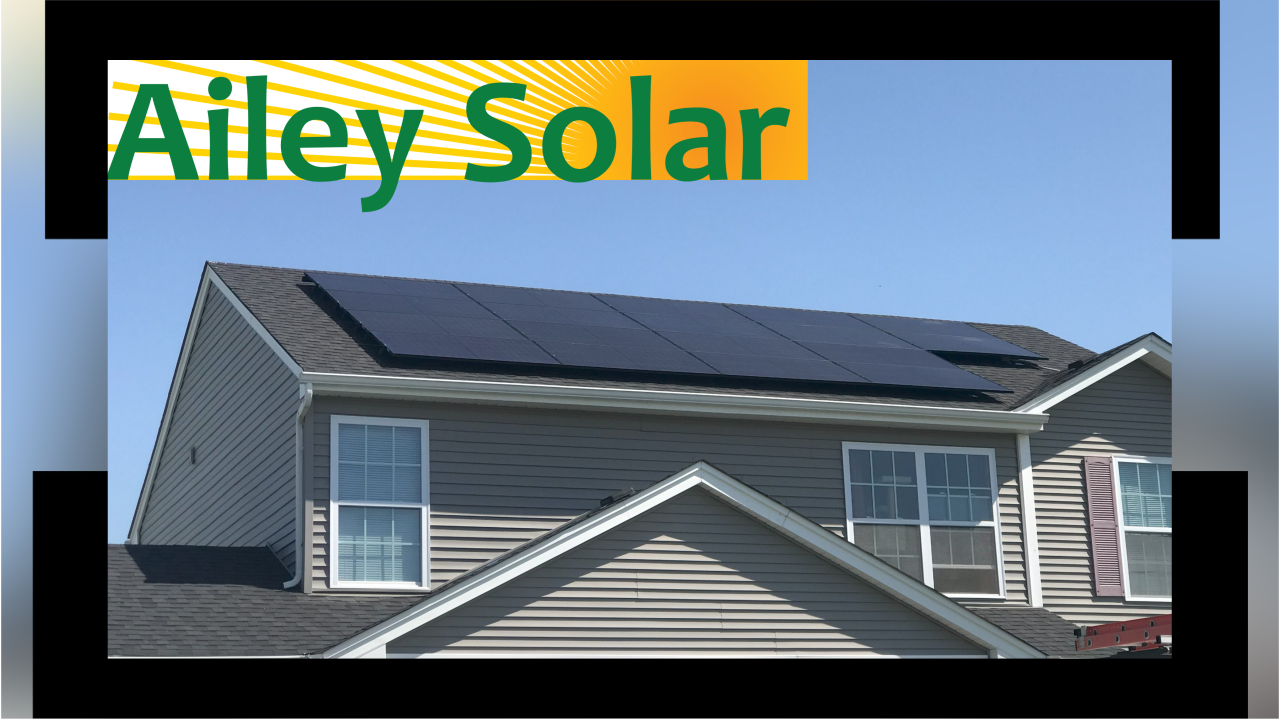
Co-founded by Jack and Dorian in 2007, Ailey Solar has become Chicagoland’s longest-serving residential & commercial solar installers, helping homeowners and businesses make the switch to renewable energy.
Nearly two decades later, however, Ailey Solar’s perspective on America’s clean energy transition has become more nuanced.
Solar technology has advanced. Incentives have helped create demand. States such as Illinois have emerged as significant solar markets.
Yet for an industry built around making energy more accessible and cost-effective, Breuer believes doing business in solar can still be unnecessarily complicated.
From environmental activism to solar
Ailey Solar’s roots stretch back to a period when the American solar industry looked very different.
Ailey Solar’s early involvement in environmental advocacy centered partly on Chicago’s reliance on coal-fired power generation. Solar offered an opportunity to approach the same problem from another direction.
Instead of only campaigning against traditional sources of energy, there was an opportunity to help build an alternative.
That mission has remained an important part of Ailey Solar’s identity.
The company has spent years installing solar systems across the Chicagoland area, with much of its business coming through word-of-mouth referrals.
Illinois has also provided fertile ground for that growth. State and federal incentives have helped make solar financially viable for more households and businesses, while Illinois has developed into one of the country’s more significant solar markets.
For Breuer, incentives demonstrate just how influential public policy can be in determining where renewable energy industries grow.
But that influence cuts both ways.
The solar industry’s regulatory problem
After years working inside the industry, Breuer sees regulation as one of the biggest forces shaping the solar economy.
“One of the biggest drivers of the solar economy is regulation,” Breuer says. “Good policy can move the industry forward very quickly, but unnecessary complexity can make doing business much harder than it needs to be.”

Incentives and tax credits can accelerate adoption. At the same time, complicated permitting requirements, differing standards and inconsistent support from utilities can make projects more expensive and difficult to deliver.
Part of the challenge is that solar companies operating across the United States can encounter different rules and requirements depending on where they operate.
Breuer points to Europe as an example of how more streamlined permitting can reduce some of that friction.
In the U.S., meanwhile, differing state and local standards can introduce additional layers of complexity. Requirements around wages, insurance, permitting and utility applications can all affect the economics and timeline of a project.
“We’ve made solar more complicated than it needs to be,” Breuer says. “The technology works and the demand is there. What businesses need is a regulatory environment that makes it easier to deliver.”
Solar was supposed to save you money
There is an irony in all of this.
At its simplest, solar is supposed to make economic sense.
Households and businesses invest in technology that generates electricity from an abundant renewable resource, potentially reducing their dependence on grid-supplied power and lowering energy costs over time.
But the more complicated it becomes to approve, install and qualify a system for available incentives, the harder that basic proposition can become.
“Solar should be affordable and easy to access,” Breuer says. “But complicated processes can make it more expensive and difficult for businesses to deliver.”
For economic development organizations, that distinction matters.
Attracting clean energy investment isn’t simply about announcing incentives. The regulatory environment and support from the utilities surrounding those incentives can determine how easily companies are actually able to use them.
A generous program can encourage investment, but complicated and lengthy permitting and coordination with utilities, inconsistent standards, or costly requirements can also chip away at that advantage.
Illinois offers an example of what incentives can accomplish. For companies such as Ailey Solar, however, the next step is ensuring the systems surrounding those incentives work just as effectively.
More solar, more power
There is also a much larger issue sitting behind the industry’s growth.
America needs electricity.
The expansion of data centers and other energy-intensive industries is placing greater demands on the grid, while questions remain around whether existing infrastructure can consistently accommodate growing electricity consumption.
Breuer sees distributed solar as one part of the answer.
“We’re asking the grid to support more and more electricity demand,” Breuer says. “Solar can be part of the solution, but we have to make it easier to actually put that generation where people and businesses need it.”
Generating electricity closer to where it is consumed can help diversify the country’s energy mix and potentially reduce some pressure on centralized infrastructure.
But Breuer also sees a disconnect in how America’s energy priorities are being approached.
While renewable energy businesses navigate regulatory complexities, large power users such as data centers are adding significant new demand to the system, and conventional sources of generation continue to receive policy support.
Solar, meanwhile, is increasingly being asked to help satisfy those growing energy requirements.
For Breuer, that makes the regulatory conversation about more than the fortunes of individual solar businesses. It is increasingly about how communities prepare for a future in which electricity demand could look very different from today.
Keep the green transition simple
After nearly two decades in solar, Ailey Solar’s Breuer isn’t arguing that government has no role in the industry.
Quite the opposite.
Ailey Solar’s experience demonstrates just how powerful policy can be. Federal and Illinois incentives have helped create markets, encourage investment and make renewable energy accessible to more customers.
The question is whether the next phase of clean energy policy can combine those incentives with something less headline-grabbing but equally important: simplicity.
For communities hoping to attract renewable energy businesses and investment, that could mean looking beyond how much support is available and asking how easily companies can actually navigate it.
Ailey Solar started out trying to change Chicago’s energy landscape through environmental activism.
Almost two decades into building solar systems, the mission hasn’t disappeared.
But perhaps the challenge has changed.
“The goal should be pretty simple,” Breuer says. “Solar needs to work for the homeowner, it needs to work for businesses, and it needs to work for the community. The easier we make that happen, the more people will use it.”