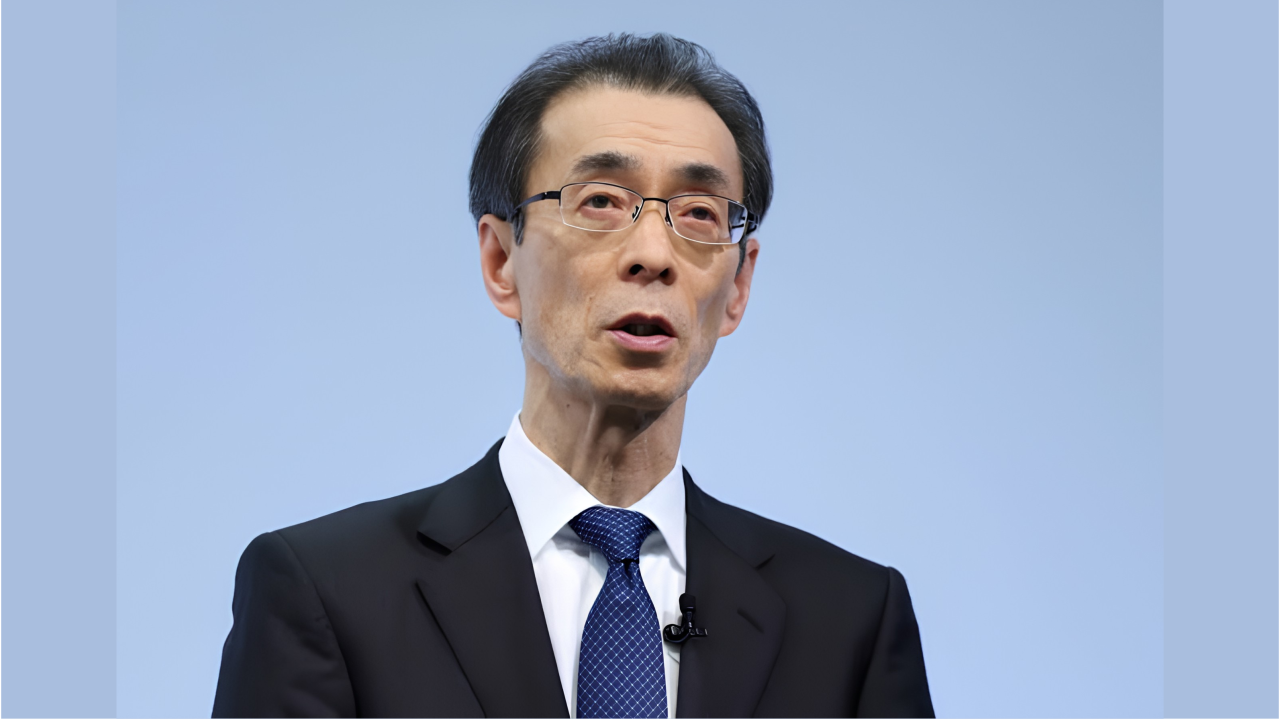

Speaker Tiff Macklem Governor, Bank of Canada Presider Roger C. Altman Founder and Senior Chairman, Evercore; CFR MemberC. Peter McColough Series on International Economics Tiff Macklem of the Bank of Canada discusses the major trends and challenges facing the global financial architecture, what’s at stake for Canada, and how to evolve it for the 21st …
C. Peter McColough Series on International Economics With Tiff Macklem

Speaker
Governor, Bank of Canada
Presider
Founder and Senior Chairman, Evercore; CFR MemberC. Peter McColough Series on International Economics
Tiff Macklem of the Bank of Canada discusses the major trends and challenges facing the global financial architecture, what’s at stake for Canada, and how to evolve it for the 21st century.
The C. Peter McColough Series on International Economics brings the world’s foremost economic policymakers and scholars to address members on current topics in international economics and U.S. monetary policy. This meeting series is presented by the Maurice R. Greenberg Center for Geoeconomic Studies.
ALTMAN: All right. Good afternoon, everyone. Welcome to the Council and welcome to the McColough Series on International Economics. I’m Roger Altman. And I have the pleasure of welcoming Tiff Macklem, the governor of the Bank of Canada, our guest for today’s session.
We’re quite fortunate to be joined by Mr. Macklem. He is a deeply experienced central banker and monetary expert, having spent much of his career at the Bank of Canada and having served as its chief operating officer prior to becoming governor. I might also say that this is a good moment for this conversation, as key central banks are approaching their tapering phase and considering their exits from the extraordinary monetary stimulus which they’ve been supplying to the global economy since the early 2020 eruption of the pandemic. So we’re quite pleased to have Mr. Macklem today.
He’s going to deliver a series of prepared remarks. I will follow those with a few questions of my own and then we will open it up to members’ questions. As you have just heard, this session is on the record.
And with that, welcome, Mr. Macklem. The floor is yours.
MACKLEM: Well, thank you, Roger. Thank you for that kind introduction. I must say it is a real pleasure to be here, virtually at least, and I am very much looking forward to the opportunity of meeting in person. But we need to invest in international cooperation and it can’t wait, so I’m thrilled to have the opportunity to speak with you today. I know we’re going to have some thoughtful and engaging conversation despite this virtual format.
My hope is that we can take inspiration from the cooperation among researchers who developed effective vaccines against COVID in record time. Their efforts and collaboration are saving lives and livelihoods. This is underpinning the global economic recovery and this is international cooperation at its very best.
Tragically, there hasn’t been nearly as much success in ensuring the equitable global distribution of vaccines, especially to developing countries. This is the biggest health and economic risk facing the world, and as the G-20 highlighted in July, governments and the private sector need to work together to make vaccines available to all.
Now, while global public health is the most urgent challenge for the—for international cooperation, the international monetary and financial system is one of the most enduring. August marked the 50th anniversary of the end of the Bretton Woods system of fixed exchange rate. Canada exited early, moving to a floating exchange rate in 1970. This was a year before the United States suspended convertibility of the US dollar into gold and most major currencies—most major countries floated their exchange rates. This anniversary provides a timely occasion to reflect on the international monetary and financial system that has emerged, and how well equipped it is to deal with the challenges ahead.
This global system—the exchange rate, capital accounts, as well as the institutions and rules that govern them—affects everyone and is critical to our shared prosperity. The investments we’ve made collectively to strengthen the system have allowed us to clear some hurdles, but we need a system that better balances the immediate imperatives of the short run with the important building blocks for longer-run prosperity. That’s what I want to talk to you about today.
(Speaks in French.)
(Continues in English.) We aspire to an international monetary and financial system that favors inclusive and sustainable growth. In the long run, that is best achieved by a system that promotes economic integration with free trade, open capital markets, and flexible exchange rates. But the current system isn’t there yet. And while we aspire to the long run, we live in the short run.
For both these reasons, policymakers face a delicate balance. Too much confidence that open markets will always deliver economic and financial stability increases the risk of volatile episodes that hurt jobs and growth, but too much focus on managing short-run pressures risks thwarting the medium- to long-run adjustments that are fundamental to productivity and rising standards of living. Finding the right balance between managing short-run pressures and ensuring steady progress toward liberalization is the crucial task of the international monetary and financial system.
While much progress has been made in the fifty years since the end of Bretton Woods, achieving this balance remains elusive. And looking ahead, it’s not going to get easier or less critical. As the recovery from the pandemic progresses and major economies begin to remove exceptional monetary stimulus, the system will likely come under more pressure. Tighter financial conditions globally will suit some countries better than others. And beyond the pandemic recovery, new and even bigger challenges are on the horizon, including climate change, the digitalization of currencies, and growing inequality.
In my time today, I’d like to talk about Canada’s place in the global monetary and financial system. Then I’d like to highlight some of the challenges the system faces, particularly in the wake of the COVID crisis. Finally, I’d like to outline our vision for the 21st century.
Cross-border economic integration has been a critical source of increased prosperity for Canadians and for citizens the world over. To be effective, the international monetary system needs to deliver stability in prices and allow exchange-rate movements that reflect fundamentals. At the same time, it must be able to adjust to shocks and structural changes in a timely way.
In Canada, we have a longstanding experience with open capital markets, inflation targeting, and flexible exchange rates, and they have served us and a growing number of countries well. Still, weaknesses in arrangements and policies that make up the international financial system are longstanding. Over the past two decades, the Bank of Canada has emphasized the need for sound economic and financial policy frameworks in advanced and emerging-market economies and sound governance of our global institutions. My predecessors and I have certainly spoken about this often.
Progress has made the system better able to prevent and manage crises. The IMF has strengthened its surveillance, enhanced its financing facilities, and developed a framework to guide the use of capital controls. Policy frameworks in many emerging-market economies have been strengthened with the wider use of inflation targeting and greater flexibility in exchange rates. The Basel III reforms have made financial regulation and supervision stronger. Swap lines and reserve pooling between central banks have expanded. And advanced economies have also become more attuned to the spillovers their policies might cause.
This progress has helped the global economy weather the COVID shock, but the crisis has also reminded us of the connectedness and fragility that are inherent to the system. As we all know, massive liquidity interventions by central banks were needed to restore market functioning and support the provision of credit. The interconnections in the global financial system across countries and between banks and other financial institutions have brought great benefits, but these interconnections have also propagated and amplified stress. The test we faced together during the COVID shock as well as the challenges that lie ahead underline the need to refocus our attention on where the system should be headed and how to get there. The fallout from the pandemic and the inevitable adjustments ahead make dealing with these issues more urgent.
The current challenges facing our global system can be grouped into two categories: short-run pressures and longer-run challenges. So me start with the short-run pressures.
Emerging-market economies have continued to experience volatility in their financial conditions despite improvements in fundamentals that have resulted in fewer full-fledged crises. In the last dozen years, episodes of global stress have become all too frequent: the global financial crisis in 2008, the taper tantrum in 2013, the China selloff in 2015, and the selloff in emerging markets in 2018. The COVID shock dwarfs these in global scale and reach. In March 2020, capital flew out of emerging markets at a historic pace. While the situation has since stabilized, capital outflows could happen again when the largest economies start reducing the extraordinary stimulus.
To address similar circumstances emerging-market policymakers have used a variety of measures, including restricting capital flows and intervening in foreign-exchange markets. These policies have gained increased acceptance, and there are circumstances in which they can be justified and effective in managing short-run pressures. At the same time, these policy interventions can thwart or delay necessary adjustments in their economies, and they can stunt the development of domestic financial markets and products. Appropriate guardrails are required to ensure that short-run actions do not get in the way of needed development. Otherwise, the short run can become the long run.
There’s another knock-on effect. Faced with elevated volatility, emerging markets are taking out more insurance by accumulating reserves. At a minimum, this self-insurance looks globally inefficient. And this demand for reserves is contributing to a shortage of reserve assets, which may be reinforcing the decline in the neutral rate of interest. This, in turn, raises the risk of liquidity traps that can lead to the buildup of financial vulnerabilities everywhere.
Now, turning to the longer-run challenges, there are several.
The first involves the welcome evolution of countries from frontier to emerging market to advanced economies. As these economies grow and increase in importance, their integration into the international monetary and financial system will become more pressing.
A second longer-run challenge is the choice of exchange-rate regime. We’ve seen how freely floating exchange rates may lead to excessive volatility in response to short-run disturbances. But to accommodate longer-run structural changes that are essential for sustained development, some margin of flexibility is needed. If nominal exchange rates remain fixed, then all domestic prices and wages have to adjust, and this can be protracted and painful.
As we consider these challenges together, the right balance is crucial. We need a vision for the international monetary and financial system of the 21st century in which emerging markets will form an increasing share of the global economy while gradually developing their financial systems. This vision for the long run cannot rely merely on a utopian system where all participants have mature, well-regulated financial systems, fully open capital accounts, and floating exchange rates. We must be mindful that some are closer to the destination than others.
In discussing this vision, I want to focus on three priorities: the need to find balance between short-run policies and long-run progress, the value of a framework for currency intervention, and the need for global cooperation and resources.
Over the past decade, the focus has been on widening the set of policies countries can use to deal with temporary external shocks. This is welcome and it’s reflected in the IMF’s Institutional View. But there’s not been enough attention to ensuring that these policies do not impede longer-run progress. Many emerging markets seem to be settling for intermediate exchange-rate regimes with more or less regular foreign exchange interventions. This risks slowing structural adjustments that are needed in the real economy. It also risks exacerbating the very pressures these short-run tools seek to manage. By thwarting adjustment, they can cause pressures to build up, leading to greater volatility.
Finding balance means allowing countries to respond to excess volatility or disruptions in the short run while making the system flexible enough to adjust in the long run. Progress has been made in the IMF’s Institutional View, which supports the use of macroprudential policy to manage financial stability risks. And only if macroprudential measures are insufficient should capital-flow management be considered. But more work is required to understand the implications of short-run policies for longer-run financial development.
Currency intervention needs attention as well. A freely floating currency may not provide as much benefit to some emerging markets as we once thought. Dominant currency pricing reduces the benefits of exchange-rate adjustment for some countries and currency mismatches on balance sheets increase their costs. But the system needs guardrails to make sure currency intervention does not get in the way of needed relative price adjustments. At the Bank of Canada, we’d like to see the development of a framework for exchange-rate management similar to the IMF’s Institutional View for capital-flow management. Such an agreed-upon framework could guide managed floating regimes to make sure they don’t stall needed adjustment in the real economy.. The focus here should be on a—the coherence between the choice of exchange-rate regime and other policies.
(Speaks in French.
(Continues in English.) In the end, policymakers need to recognize that capital account and currency interventions should be targeted to address specific concerns and they should be temporary. Over the longer run, countries should plan to rely less on these policies as their financial systems mature. In the shorter run, every time these interventions are used a clear exit plan should be in place. And the circumstances in which interventions may occur should be well-defined so exiting is easier.
Global cooperation and resources are also required to agree on a long-run vision for the international system. Considerable resources have been devoted to the management of short-term liquidity and volatility issues, and that has been necessary and important. Global policymakers need to balance this effort with greater focus and resources to promote longer-term economic and financial development. The IMF’s multilateral role in surveillance is essential. The global system needs to be managed as a system. And the Financial Stability Board is doing valuable work with peer review assessments and other assessments to strengthen adherence to international standards. My hope is that we can build on these elements to deepen the engagement of important economies on an international system that maximizes the benefits of economic and financial integration.
In Canada’s experience, the destination is one with open capital markets, robust and transparent policy frameworks—including monetary, fiscal, and macroprudential policies—and enough exchange-rate flexibility to promote the timely and symmetric adjustment to shocks. Effective and legitimate multilateral institutions are essential to this destination. To this end, continuing efforts to improve governance in these institutions are important.
Well, let me conclude here so we have enough time for a good discussion. I want to leave you with a sense of urgency and purpose. The pandemic and the looming challenges ahead, including climate change and digital currencies, make it more important than ever that the international monetary and financial system evolves. We need a clear long-run destination that everyone is committed to and a framework to manage short-run challenges in a way that doesn’t derail us from that ultimate destination. What we need is an international monetary and financial system that can handle, even facilitate the transitions to come, including the exit from exceptional monetary policy, the transition to net zero emissions, and the potential digitalization of the international monetary system. I really look forward to your questions and the discussion. Thank you.
ALTMAN: Thank you, Mr. Macklem, for those very lucid and excellent remarks.
Let me start my own questions with this one. You mentioned in your comments the increased volatility of financial markets. In fact, you referred to shocks which was seen over the past ten to fifteen years, and I want to ask you about that. Twice in just the last twelve years, in 2008 and in early 2020, we saw circumstances which caused, at least I would argue, global financial markets to freeze, to stop functioning at least briefly, risking real global meltdown. And only massive intervention by central banks, led by the Federal Reserve, involving colossal amounts of support, enabled markets to stabilize. So I have two questions. First, why do you think these crises—and those were certainly two of the worst we’ve ever seen—are occurring more frequently? And second, do you think that global central banks on a—and global financial regulators are truly ready for the next one?
MACKLEM: OK. Well, two big questions.
Let me start with the first one. You know, every crisis is different. This crisis is very different from the global financial crisis. In many ways, the global financial crisis reflected the fact that we built a financial system that was too vulnerable. You know, capital buffers were wafer thin, assumptions about liquidity were heroic, leverage was excessive. And, you know, faced with a shock with, you know, started, as you well know, in the subprime sector of the U.S. housing market, we came very close to a global meltdown of the financial system.
You know, coming out of that I think we—you know, we did learn some important lessons. And there’s been a really concerted effort to substantially improve the resilience of the global financial system. You know, capital regulation, liquidity rules, limits on leverage have all been strengthened. And, you know, I would underline that those investments really paid off in this most recent crisis. You know, banks have been—you know, this time around banks have not been the problem. In fact, banks have been part of the solution. They’ve been acting as shock absorbers rather than amplifying the shock.
You know, this time it was a global pandemic, something nobody foresaw. You could certainly argue we could have made more international investments in public health to be able to manage this better. And I expect there’ll be a lot of reflection on that. And, as you said, you know, markets completely froze in the acute phase of the crisis. Central banks, led by the Federal Reserve, came in in massive scale. The Bank of Canada stood up something like eleven liquidity and emergency purchase programs. That worked. We did restabilize financial markets. Markets are very much open. And, you know, that is a fundamental role of central banks. When markets simply seize up, that’s why you have a central bank, to ensure that credit keeps flowing.
But to get to the second part of your question, what about the vulnerabilities? You know, what are the—what could happen next? I think the—you know, the investments we made coming out of the ’08-’09 crisis did pay substantial dividends. But this crisis, and particularly in that acute phase, it did reveal that there are some important vulnerabilities in short-run funding markets. And I think one thing we’ve seen is that with the growth of the non-bank financial sector—so, large pension funds, other large asset managers, other players—they are becoming increasing demanders of liquidity. And they’ve become larger relative to the banks that are the providers of liquidity in a crisis.
And that clearly contributed to this rapid freeze up in the global financial system. And as I said, you know, central banks, you have them there to deal with, you know, true crises. But where there are underlying vulnerabilities, we need to—you know, we need to fix those. We need to make the system more resilient. You know, we don’t want to be bailing out things or rescuing things that were already vulnerable. You know, that’s creating moral hazard. That distorts capital flows. You know, that’s not what we should be doing. So there is some important work to do following up on the crisis, looking at the interaction between banks and nonbank financial institutions, looking at the liquidity needs of the nonbank financial system. The Financial Stability Board is leading that work. And I must say, I think it’s going to be important that we drive forward on that.
ALTMAN: Thank you. At the conclusion of your prepared remarks, you mentioned three transitions that are coming up for the international monetary financial system. And I want to ask you about two of those. One of them, which you cited but didn’t really elaborate on, is the potential digitization of the international monetary system. So I have two questions here. Do you actually see the monetary—the global monetary system ending up in a strictly—in a true digital order, only digital? And secondly, what is your point of view of the various private cryptocurrencies that are out there today? Our former Fed chairman and current secretary of the Treasury, Janet Yellen, for example, has been quite dismissive of them.
MACKLEM: Well, that’s probably the topic for a whole other speech, but let me give you a few preliminary thoughts there, Roger. You know, do I imagine a fully digital order? No, I don’t. I think at least—you know, I think what we’ve seen is—look, the world is increasingly digitalizing. This pandemic has only accelerated that. We’ve all learned to do a lot more things digital, including this discussion. So and, you know, against that background, the demand for digital payments, means—perhaps digital currencies—is becoming bigger. So I do—I don’t think that trend is going to reverse, and I think it’s going to be very important for central banks to prepare for the day that—of digital currencies. I don’t think we are there yet. We’re not there yet, but I think we need to prepare for it. But at least, you know, for the foreseeable future, I certainly imagine that even if we were to have digital currencies, we would still have physical banknotes.
You know, with respect to the international system, you know, I think this issue of the digitalization of the monetary system, you know, it’s exactly—it’s a really good example of the kind of longer-run issue where I think we need a lot of focus and cooperation at the—at the international table. And this is certainly going on. There are many dimensions to this. You know, one element, of course, if we start to have digital currencies in countries it’s going to be very important that there’s interoperability so that we can have efficient cross-border payments. I think one of the—one of the—you know, right now cross-border payments are not as efficient as I think we’d like them to be. That—so that’s a sort of technical dimension. And the Bank for International Settlements, actually, is working—central banks are working on this through the Bank for International Settlements, through the setup of a number of innovation hubs, one of which is coming in Canada, in Toronto.
You know, another dimension is the potential for spillovers in a digital system. You know, what we’re seeing is more things are digital, the faster everything moves. And that has the potential for faster and more serious spillovers. The IMF is doing a fair amount of work on the potential spillovers from international system. There are also financial stability issues. You know, if you have a digital currency, could that, particularly in a stress period, compete with deposits at banks? And if you start to see deposits fly out of banks into digital currency, that could—that could become destabilizing to the financial system. The Financial Stability Board is looking at a range of financial stability issues. The G-7 is looking at this, other bodies are looking at this.
I’ll also say, this issue has many dimensions. And it’s going to take a lot of international cooperation so that we’re in a position to benefit from the potential gains from having digital currencies and a more digital economy, without creating unintended consequences. I mean, with respect to the particular private sector digital currencies, I would say, you know, there are lots of crypto assets out there. There’s not really any cryptocurrency. There’s nothing that’s really being used in transactions as a—as a digital currency. Maybe somebody will crack the business model, but it hasn’t—it hasn’t really happened yet.
ALTMAN: OK. Another transition you refer to is the importance and the sensitivity of a smooth exit from the extraordinary monetary stimulus centered around QE, which we’ve seen for the past eighteen to twenty-four months around the world, since the pandemic erupted. And my question is a simple one: The amounts of that intervention have been absolutely staggering. The size of your balance sheet, the Bank of Canada balance sheet, I believe is up about 300 percent during this period. M2 in this country is up 13 percent year over year. And if you look at the United States, Europe and China, the equivalent of M2 is up about 10 percent year of over. So one is tempted to think that the exit for central banks from this phase of extraordinary measures is going to be challenging, is going to be difficult. Tell us how you see that being managed and how you think it can avoid being bumpy, because one is tempted to think it’s inevitably going to be bumpy.
MACKLEM: Well, look, I think, you know, it’s—there are likely to be some bumps, but I think there is good prospects that it can be managed. You know, we—there are many features of this pandemic. One of the really unique features is we all went in it almost at exactly the same time. The acute phase was pretty much the same everywhere in the world. You know, major central banks around the world responded in a very similar fashion, in scale, very quickly. Governments responded with extraordinary fiscal support at roughly the same time. As we come out, countries are coming out at different speeds.
And that reflects a few things. It reflects that, you know, the virus itself is—you know, it’s ebbing and flowing in different places. The distribution of vaccines is uneven globally. Places that have less vaccination are facing bigger hurdles. The capacity of countries to provide exceptional monetary and fiscal support is different, and countries have different industrial structures. So for all those reasons, we are—we’re coming out at different speeds. And that is going to put—that means there’s going to be more work for the international monetary system to deal with. There’s going to be more adjustment.
You know, what I would say in terms of, you know, making this as smooth as possible is that I think central banks, particularly, you know, major central banks, they are more attuned to the fact that their policies have spillovers. And I think what you’ve seen—central banks have really been going out of their way to be very deliberate in their analysis and deliberate in their communication. If you can avoid surprises—you know, when you create surprises, the potential for spillovers is larger. To the extent that you can minimize surprises, it will be smoother.
More broadly, though, I think the reason I mentioned it in the speech is it really highlights the face that when there are bumps, we need some short-run tools, particularly emerging markets need some—economies—need some short-run tools to manage those, so they don’t derail their recovery. But we’ve also—we’ve got to make sure we don’t overuse those tools because by blocking adjustment they can actually cause more pressures to build up, which then creates further volatility. And, you know, there’s been a lot of focus on the need for more short-run tools. And, you know, that is important, and it’s welcome. But we do need to make sure that we keep the focus on making sure we’ve—we’re focused on the destination, and that we’re not derailing the liberalization we need to have a well-functioning global system.
ALTMAN: OK. I may be down to my last question, just given the time here, and that is about inflation. A lot of people in finance are learning that the most important word in the English language is “transitory.” My question is, and I think this is the question of the hour in financial markets in inflation. Canadian inflation rate, I believe, you can correct me, is in the threes. U.S. inflation rate, most recent data, is about 4 ½ percent using core PCE. We’re seeing big surges in things like commodity prices and rents. And I mentioned earlier the surge in the money supply.
So my question simply is: How confident are you that inflation in the developed world—and, of course, it’s proceeding in different rates in different places. As Christine Lagarde said a couple days ago, it’s a lot lesser right now in Europe than it is in the United States. But how confident are you that this really is transitory? Because right now if you took a poll of smart people in finance, or people who think they’re smart, you’d probably get 50 percent saying it probably is, and about 50 percent saying it probably isn’t.
MACKLEM: Well, at the end of the day it’s the job of central banks to make sure it is. (Laughs.) That’s the bottom line. But let me—let me back up a little bit. So, you know, when—you know, as you said, inflation has come up in Canada. We have a 2 percent target with a 1-3 percent control range. And inflation is running above that control range. July it was 3.7 (percent), August 4.1 (percent). So it is running above our control range. And we actually expect it’s going to stay above our control range through the end of this year.
So what’s pushing it up? Well, when you unpack the prices that are going up that are pushing inflation up, what you see is they’re very related to the unique circumstances of the pandemic. And there’s a few parts to that. One is what we call base year effects. You know, at the acute phase of the pandemic prices were very low. Inflation was actually briefly negative. So even just as prices normalize on a year over year basis you get a big increase in the inflation—price increases in some goods.
Secondly, there are a number of material disruptions to global supply chains. And this is—this is, you know, affecting particularly things like computer chips. That is feeding into higher prices for cars, for example, and other electronic products. You know, that seems to be related to a very specific issue related to the pandemic. The other—the other sort of broader effect you’re seeing is there’s bottlenecks in delays in global shipping, ships lined up outside the port in L.A., for example. That’s driving shipping costs up, which gets reflected in other goods. And it also causes delays, which creates shortages, that drives the price of some goods up. So when you look at—and you can see these effects in various goods’ prices.
You know, these things appear to be related to the specific—the very unique circumstances. And we do expect that these supply factors will work their way through. You know, we’ve seen these—and, you know, lumber is a good example. You know, a few months ago lumber was four times its pre-pandemic price. Now it’s come back down. So we are working through these supply disruptions, but I will say they are proving more complicated. They are continuing. So there is some risk that these—there’s a bit more persistence than we previously thought. But when you look at it, I think there are good reasons to believe that they are temporary.
The other thing I would say is, you know, go back where I started. There’s a difference between a price increase and ongoing inflation. And our job is to make sure that a once-off price increase doesn’t become ongoing inflation. And in that regard, there are some things we are really looking at. We’re looking very closely at measures of expected inflation. And, you know, not surprisingly measures of short-run expected inflation have gone up with observed higher inflation. But if you look at measures of medium to longer-run expected inflation, they have remained very well anchored.
The other thing we’re looking at is wages. And, you know, want we want to see is that wage growth is in line with productivity growth. Wage growth in Canada to this point is fairly moderate. We’re not seeing any evidence that wages are running ahead and are becoming an independent source of inflation. So we’re going to continue to watch these things closely. You know, it does remain to be seen how persistent these things are. But we will be, you know, watching that closely and looking for any signs of broadening.
ALTMAN: Thank you. We’re going to open this up now to Council members and their questions. And I would just remind members to please be succinct. And, again, this is on the record, so I’ll hand this off for selecting questions.
OPERATOR: (Gives queuing instructions.)
While we wait for our first question to come in, I’ll hand it back to you, Mr. Altman.
ALTMAN: Well, then let me ask another one. And that is about labor markets. It’s an odd moment in labor markets, at least in this country, because we have both tightness—which many people are referring to as labor shortages—and slack. There are five million people in the United States who were employed at the beginning of 2020 and who have yet to return to the labor force. And since monetary policy is charged with addressing both full employment and price stability, tell us how much slack in labor markets exists in Canada today, and how much of that do you think will resolve itself naturally in terms of workers ultimately returning to the labor force?
MACKLEM: Well, thank you for the question. And I was tempted to get into in my previous answer on inflation, because obviously they’re related. So, you know, in Canada the dynamic of the labor market is broadly similar to the United States, particularly we are reopening. Easing of containment restrictions was a little later in Canada than in the United States. So over the summer, those containment restrictions were eased. Restaurants reopened. Domestic tourism came back to life. And we saw some, you know, solid job gains, particularly in these hard-hit sectors. And that’s particularly important because it’s reducing the extreme unevenness we’ve seen in the labor market. There still is unevenness, but with these hard-hit sectors reopening and bouncing back, that is reducing the unevenness.
But at the same time that we saw solid job gains, we also, as you indicated, saw, you know, a fairly marked rise in job vacancies or, you know, as you said, people often call those job shortages. And I think, you know, again, this looks like it’s reflecting the very unique circumstances of the pandemic. We’ve never reopened an economy before. And I think what we’re seeing is reopening an economy is a lot more complicated than closing one. And, you know, companies are looking for the right workers. Workers are looking for the right jobs. And that process is taking some time. And I guess what we’re seeing is that, you know, even at the same time as—so, in Canada, unemployment’s still over 7 percent. Long-term unemployment is still quite elevated.
So it is very unusual to both have higher unemployment and high vacancies. And in the labor market, it takes time for workers and companies to match up and find the workers and the jobs they want. That’s going to take some time. We do think, though, that, you know, we’re going to work through these frictions in the labor market. It may take a little longer than we previously thought, but the fact that there’s still job vacancies suggest we should continue to see some good employment growth.
ALTMAN: OK. I’m going to turn this back for a question from one of the CFR members.
OPERATOR: We’ll take our next question from Dee Smith.
Q: Thank you very much. Very interesting overview of the situation globally. My question—I’m Dee Smith. I’m CEO of Strategic Insight Group and board chair of the Lozano Long Institute of Latin American Studies at University of Texas at Austin.
My question is: How do you account for the interactions between various elements that bring new crises? And I’ll give a concrete example. There was a report yesterday that the oil spill off of California was caused by an anchor of one of these ships moored off of Long Beach that essentially scraped across it and broke the pipeline. So it’s this idea of cascading crises and interconnections between crises that are not apparent until they arise, which is sort of the theme of the last fifteen years, I guess. And how do you account for that in your economic models? And is it given that, you know, quality that’s inherent to the hypercomplex system we’ve created—is it really reasonable to think we’re going to return to the old normal? Or are we going to come to some new normal or some kind of unstable situation that we haven’t faced before? Thank you very much.
MACKLEM: Well, let me tackle that question on two dimensions. I think there is a broader trend that certainly predates the pandemic. And it probably has been—you know, it probably is accelerating. And that is that everything is getting more interconnected. Things are getting more tightly coupled. And everything is moving faster. So when something—so there’s—when things are more connected, they’re moving faster, and we’ve designed a lot of the system for efficiency, you know, if we—if we don’t make enough investments in redundancy and resilience, we get more frequent—more frequent crises.
I mean, not everything is a full-blown crisis, but more—you know, more problems that spread more quickly. So, you know, that’s a general feature, I think, of pretty much all economic systems globally. And certainly in financial markets we’ve seen this. We’ve seen this interconnectedness tremendously in various crises. And, you know, that’s why we’ve—you know, especially coming out of ’08-’09, spent a lot of time investing in trying to improve the resilience of the financial system. As I mentioned earlier, that’s—you know, while there’s certainly some more work to do, that has been very successful.
I guess with respect to emerging markets, I think one thing that I think they’ve experienced is that they have made important investments in strengthening their policy frameworks and in improving the development of their domestic financial systems. And that has been helpful. We are seeing less full-blown crises in emerging markets, but we’re still seeing a lot of short-run volatility that is impacting them. You know, and unfortunately what happens in financial markets doesn’t stay in financial markets. It has real impacts. It affects jobs and growth. And that has put a lot of focus on the need for better tools to manage these episodes of short-run volatility.
And I think, you know, as I said in my remarks, that’s welcome. That’s important. We do need, though, to not lose sight of the fact that there are real benefits to liberalization. There are real benefits to having enough adjustment in the international monetary financial system that new pressures don’t build up, and then sort of pop. You know, if we can—I think more focus on getting a better functioning system would help manage the fact that we do have a more tightly coupled world. It is more interconnected. And there are a lot of benefits to that, but we’ve got to do a better job of managing the downsides.
OPERATOR: We’ll take our next question from Ted Alden of the Council on Foreign Relations, who sends a written question asking: Can the governor elaborate on whether Canada is a strong position to weather commodity price fluctuations?
MACKLEM: Well, look, Canada’s commodities have been an important feature of the Canadian economy for really our whole history. And commodities, you know, go through cycles. You know, that’s also been an enduring feature. And so, you know, the Canadian economy has learned how to adapt to that. There’s no question that it—big changes in commodity prices put different pressures on different parts of the country. And from a monetary policy perspective, that does create a challenge. We have one monetary policy for the whole country. You know, the more flexibility we have in the country, the—you know, the better we can manage these. And we have seen flexibility increase in the last twenty years. And hopefully in this more digital world, that’ll only get better. But, yes, I mean, you know, this has—this has always been a challenge. And it’s something we’re used to managing.
OPERATOR: We’ll take our next question from Krishna Guha.
Q: Thank you very much.
So I wanted to ask about relative price and relative wage changes, and how you would approach those as a central bank governor. So in a number of economies there seems to be upward pressure on wages in low-income, high-touch occupations that have obviously come under a substantial stress relating to health risk and other things during the pandemic period. To what extent do you think we are likely to see more than a passing adjustment in the relative wages of those occupations compared with others? And how should we approach that from a policy perspective? Should we simply accommodate that and allow it to lift the general level of wages and prices? Or should we on some horizon seek to offset those increases with smaller reductions—with smaller increases in other wages and in other related price categories?
MACKLEM: Well, let me highlight a few—a few dimensions of that issue. One is that, you know, for the last at least fifteen years we’ve seen a declining share of labor income. Labor’s been getting a declining share. That has been a source of concern globally. And I think, you know, some rebalancing some of that wouldn’t be a bad thing. With respect to different types of workers, I mean, one of the things that has been really striking about this COVID crisis is how uneven the labor market impacts have been.
And, you know, the women, youth, recent immigrants, and low-wage workers have been disproportionately affected by this crisis. As I mentioned earlier, as important parts of the economy, particularly the hard-hit sectors where physical distancing is important, as those have managed to reopen we are starting to see this unevenness diminish. In particular over the summer in Canada we saw, you know, youth came back into the labor market in a very dramatic way. And really youth had been very severely affected. And that has—that has diminished.
However, low-income workers still remain much more disproportionally affected by this pandemic than others. You know, if you just—you know, in Canada if you separate workers into low-wage workers and everybody else, everybody else is now back above their pre-pandemic level of employment. Low-wage workers are still well below. So the first step is to get those people back to work. Get them back—you know, remake those connections, get them back into the labor force, get them back into a job, and restore their income.
With respect to wages, you know, from the central bank’s point of view what we aim to do is provide an overall anchor for the system. There may be a need for some relative wage adjustments, as you suggested. And you want to see those relative wage adjustments in your economy. What you have to make sure, though, is that wages overall remain in line—wage growth overall remains in line roughly with productivity growth, and so that inflation remains roughly in line with the target. So that’s how we think about it. But it’s not a simple question.
OPERATOR: We’ll take our next question from Andrew Gundlach.
Q: Good afternoon. Tiff, the American press—sorry, this is Andrew Gundlach from Bleichroeder—CEO of Bleichroeder.
The American press loves to predict the demise of the Canadian housing market, almost annually if not quarterly. I’m sure you’re doing everything you can to protect the banks from any accidents, but it seems to me that housing is being used in Canada as a retirement asset, not just a home. And there’s many, many factors there that are very complex. I’m not so much interested in the Canadian issues that are domestic and containable. I’m interested in what may not be containable. What is it that the—that the critics are seeing that causes concern for contagion beyond Canada? Can you explain the debate for us, and why—and why we shouldn’t worry about it?
MACKLEM: Well, I’m not saying we shouldn’t worry about it. (Laughs.) I mean, we have highlighted for some time that high levels of household indebtedness, which is driven very much by the housing market, is a vulnerability in Canada. But to come at this a little more globally—and Canada has been on the leading edge of this—you know, one of the features of this pandemic is that we’re all spending a lot of time at home. We’re working at home. Our children are going to school at home. All our entertainment has been at home, until recently. And as a result, you know, people want more space. They want bigger homes. And they’re less concerned about being close to the city center. They’re more—if they can get more space in a—in a community outside of the major city that’s more affordable, that’s looking more attractive to them.
So one of the unique features of this pandemic has been, you know, as we really very early in the recovery we saw a very strong demand for housing, particularly outside of the business—core business centers of major cities. And, you know, supply was not able to respond that quickly, and so you did see rising housing prices. And what concerns us particularly at the central bank is that you started to see—you start to see households overstretching. You started to see, you know, the proportion of high-ratio mortgages going up. You started to see extrapolative—some evidence of extrapolative expectations, so people feel like, OK, well, these prices are going just going to keep going up. You know, I’ve got to stretch now and get into the market now before it gets worse.
So we’ve certainly been out counseling prudence on the part of households. We’ve done a lot of analysis on the housing market. And the federal government and our prudential regulator here in Canada, the Office of the Superintendent of Financial Institutions, in the summer did take some measures—some macroprudential measures to try to reduce the risk of people overstretching. And we’ll certainly—you know, as a federal system we will continue to look at that closely.
What we are seeing now, though, is actually housing is slowing. And I think to some extent that reflects the fact that as the economy reopens this demand for extra space is diminishing. You can now go to a restaurant. You don’t have to eat everything in your own kitchen. So you’re starting—as things normalize, I think you’re starting to see some normalization there. But, I mean, household debt is high. It is a vulnerability. It is something that we are concerned about.
And Canada’s experience is pretty similar to many other countries. I know housing has come back very strongly in the United States as well. I think what’s a little different about Canada is that the vulnerability in Canada was probably higher ahead of the COVID crisis. And as it’s come back quickly, that vulnerability has come back faster in Canada than in some other countries. But Canada, in many respects, looks like a lot of other countries, particularly medium-sized countries.
OPERATOR: We have no additional questions at the moment. So, Mr. Altman, over to you for final comments.
ALTMAN: Well, I simply want to thank Mr. Macklem for a really wide-ranging and quite deep discussion of these issues. It’s kind of him to spend this time with us, and we’re grateful for that. And we wish you the best. I had a few more questions but we’ve run out of time. So thank you very much for spending this time with us, and thanks to all the members who participated today.
MACKLEM: Well, Roger, thank you. And our two countries are great neighbors. It’s a real pleasure to talk to you and the Council today. Thank you very much.
ALTMAN: Thanks again, sir.
(END)