
Sompo Holdings is moving to ramp up investments in higher-yielding overseas credit as Japan’s third-largest property and casualty insurer looks to strengthen profitability amid slowing growth in its domestic core businesses. The Tokyo-based insurer has begun redeploying investment managers from its Japan insurance subsidiary to the United States, a move aimed at sharpening its global credit investment strategy. According to Toshinobu Kondo, general manager of Sompo’s investment management department, the Japan and U.S. units are also exploring ways to cut costs by jointly selecting asset managers for transactions that may include private credit and high-yield, or junk, bonds. Sompo plans to “invest broadly in credit assets that offer high profitability and different risk-return characteristics,” Kondo said in an interview, underscoring the growing importance of asset management as a profit driver. He declined to specify how much the company plans to increase its exposure, but signaled that overseas credit would play a larger role in the group’s portfolio mix. Domestic headwinds drive overseas focus Like other non-life insurers in Japan, Sompo faces structural challenges at home. A rapidly aging population and a mature insurance market have constrained demand for traditional products such as auto and homeowners’ insurance, making sustained domestic growth increasingly difficult. As a result, major insurers have been accelerating their push into overseas markets, where returns remain more attractive. That shift is already visible in Sompo’s results. For the fiscal year ended March 2025, the group’s total operating revenue rose 4.7%, supported by an 8.6% increase in overseas revenue, …
Sompo Holdings is moving to ramp up investments in higher-yielding overseas credit as Japan’s third-largest property and casualty insurer looks to strengthen profitability amid slowing growth in its domestic core businesses.
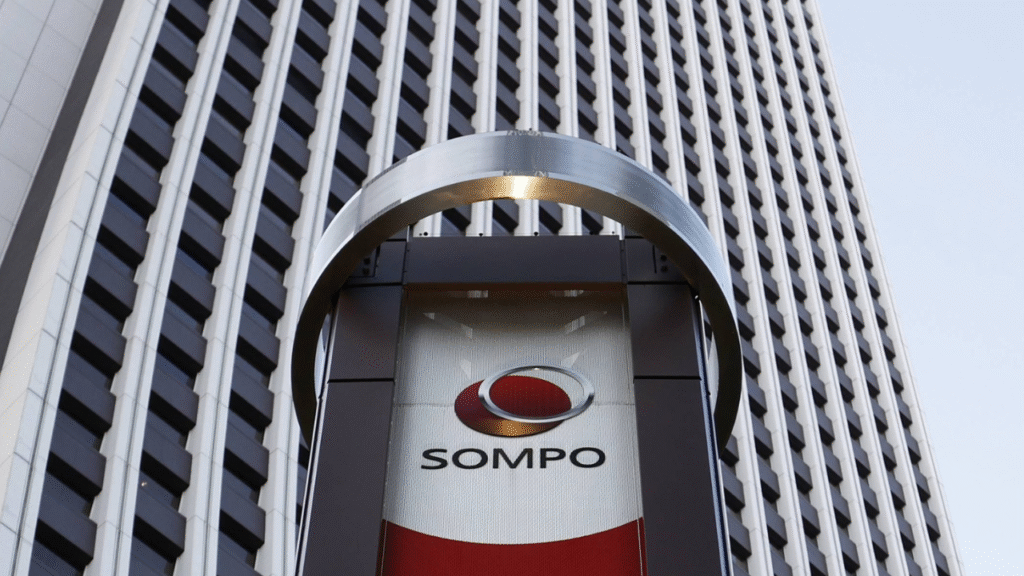
Sompo Holdings plans to expand investments in high-return credit assets. (Photo source: Bloomberg)
The Tokyo-based insurer has begun redeploying investment managers from its Japan insurance subsidiary to the United States, a move aimed at sharpening its global credit investment strategy. According to Toshinobu Kondo, general manager of Sompo’s investment management department, the Japan and U.S. units are also exploring ways to cut costs by jointly selecting asset managers for transactions that may include private credit and high-yield, or junk, bonds.
Sompo plans to “invest broadly in credit assets that offer high profitability and different risk-return characteristics,” Kondo said in an interview, underscoring the growing importance of asset management as a profit driver. He declined to specify how much the company plans to increase its exposure, but signaled that overseas credit would play a larger role in the group’s portfolio mix.
Domestic headwinds drive overseas focus
Like other non-life insurers in Japan, Sompo faces structural challenges at home. A rapidly aging population and a mature insurance market have constrained demand for traditional products such as auto and homeowners’ insurance, making sustained domestic growth increasingly difficult. As a result, major insurers have been accelerating their push into overseas markets, where returns remain more attractive.
That shift is already visible in Sompo’s results. For the fiscal year ended March 2025, the group’s total operating revenue rose 4.7%, supported by an 8.6% increase in overseas revenue, while growth in Japan was limited to 1.9%. Domestic revenue has been nearly flat for roughly five years, highlighting the pressure on insurers to diversify earnings sources.
Portfolio restructuring and policy tailwinds
Regulatory and policy changes may offer a short-term boost. Japanese policymakers have encouraged companies to unwind cross-shareholdings, long criticized for dampening competition, which has allowed insurers to book one-off trading gains from share sales. While this reduces dividend income over time, it has temporarily lifted profits.
“Further sales of strategic stock holdings and robust underwriting results are the main profit engines,” wrote Steven Lam, a senior industry analyst at Bloomberg Intelligence, in a recent report.
At the same time, underwriting itself carries rising risks. More frequent natural disasters and escalating repair costs are putting pressure on the auto insurance business, particularly as Japan grapples with its highest inflation in decades.
Watching the credit pivot
Sompo’s pivot toward higher-yield overseas credit is being closely watched given the scale of Japan’s non-life insurance sector. The company managed ¥13.4 trillion ($85 billion) in assets at the end of September, the smallest among the top three P&C insurers. Tokio Marine Holdings led with about ¥31 trillion, followed by MS&AD Insurance Group Holdings at roughly ¥20 trillion.
Globally, private credit has grown into a $1.7 trillion market. While competition has narrowed lending spreads since 2023, Sompo says the asset class remains attractive, offering wider spreads than many traditional credit products and floating-rate structures that help mitigate rising interest-rate risks.